1. Introduction: The Perspective Shift
For decades, manure and organic residues have been managed as a “problem”—a logistical burden characterized by odor, pests, and the looming shadow of regulatory fines. In the eyes of a traditional operator, waste is a liability to be disposed of. However, for the modern agricultural strategist, this mindset is becoming obsolete.
We are witnessing a fundamental shift from “end-of-pipe” disposal to a sophisticated, managed production process. The transition from a liability to a strategic resource is not a matter of hope, but a matter of engineering and operational rigor. The core premise is absolute: Organic waste is only a resource when it is controlled. By applying structured management to these streams, farms can bolster their operational resilience, secure their social license to operate, and unlock new pathways for ESG-aligned (Environmental, Social, and Governance) finance.
2. Takeaway 1: Visibility is the First Step to Value
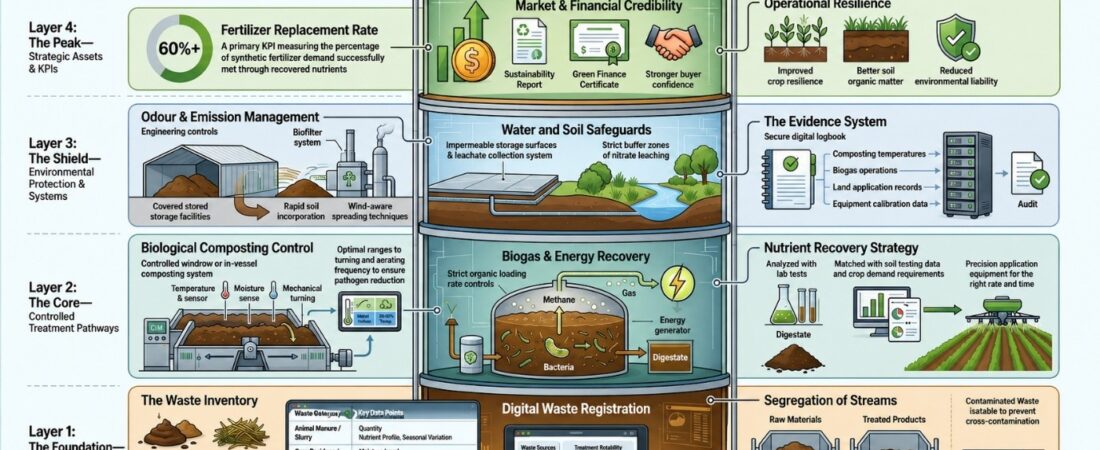
To transform waste into an asset, a farm must move toward “data discipline.” You cannot manage what you do not measure. Control begins with a comprehensive digital waste inventory that provides visibility into every organic stream on the property.
Specific waste streams requiring classification include:
- Animal Inputs: Manure, slurry, and wastewater.
- Operational Residues: Bedding material, feed waste, and crop residues.
- By-products: Spoiled produce, processing residues, and green waste.
- Treatment Outputs: Compost rejects and digestate from biogas systems.
This visibility is a form of control, allowing management to mitigate contamination risks—such as plastics or veterinary residues—and optimize storage capacity.
Good waste management starts with data discipline.
Strategist’s KPI: Total organic waste volume vs. storage capacity compliance.
3. Takeaway 2: Composting is a Biological Process, Not Just a Pile
Simply pushing organic material into a corner of a field does not constitute composting; it constitutes a pollution risk. Without active management, “uncontrolled” composting creates methane emissions and leachate that can damage crops and contaminate local water tables.
To turn a “pile” into a “soil asset,” these critical control factors must be managed:
- Carbon-to-Nitrogen (C:N) Ratio: The chemical foundation for microbial activity.
- Particle Size & Oxygen: Ensuring structural porosity for aerobic decomposition.
- Moisture & Temperature: Maintaining the biological “sweet spot” to ensure pathogen reduction.
- Maturity Assessment: Verifying stability before application to avoid nitrogen tie-up in the soil.
When these factors are documented via temperature logs and turning schedules, the output is no longer a liability—it is a verified asset for nutrient cycling.
Strategist’s KPI: Percentage of compost batches meeting final maturity criteria.
4. Takeaway 3: Biogas is a Strategic Energy System, Not a Magic Bullet
Anaerobic digestion (AD) offers a powerful pathway for methane capture and on-site energy generation, significantly improving a farm’s ESG profile. However, AD systems are complex engineering environments. Treating them as “magic bullets” often leads to operational failure.
Strategic controls for a viable biogas business case include:
- Feedstock Stability: Monitoring organic loading rates and feedstock consistency.
- Operational Integrity: Managing digester temperature, retention time, and methane leakage.
- Financial Synergy: Evaluating carbon credit opportunities and site-specific energy demand to offset utility costs.
A strategist views biogas not just as waste treatment, but as an energy and environmental control system that requires skilled labor and clear grid-connection strategies.
Strategist’s KPI: Methane capture rate and site energy demand offset.
5. Takeaway 4: Precision Nutrient Recovery vs. Disposal
Farms that view manure as a disposal problem are essentially throwing away expensive nitrogen, phosphorus, and potassium. Shifting to “Nutrient Recovery” allows a farm to replace synthetic fertilizer demand with internal resources.
Smart nutrient management requires the synthesis of several data points:
- Analytical Rigor: Ongoing manure analysis paired with soil testing.
- Environmental Protection: Identifying buffer zones and watercourse protection areas to prevent leaching.
- Strategic Timing: Utilizing weather forecasts and field-level application maps to avoid runoff during heavy rain.
- Injection Technology: Using soil incorporation to minimize ammonia loss and maximize nutrient uptake.
Nutrients become pollution when they are applied in the wrong place, at the wrong rate, or at the wrong time.
Strategist’s KPI: Synthetic fertilizer replacement rate.
6. Takeaway 5: Odor is a Leading Risk Indicator
In the modern agricultural landscape, odor is more than a nuisance—it is a threat to a farm’s “Social License to Operate.” Proactive odor management is an engineering discipline that prevents community friction and regulatory intervention before they escalate.
Practical operational controls include:
- Infrastructure: Utilizing covered storage and ensuring impermeable storage surfaces.
- Operations: Rapid soil incorporation and avoiding spreading during unfavorable wind conditions.
- Response Systems: Maintaining a formal complaint log and corrective action system to address issues before they become legal liabilities.
Strategist’s KPI: Odor complaints per month and corrective action closure time.
7. Takeaway 6: The “Separation Principle” in Physical Infrastructure
A critical strategic oversight on many farms is the failure to segregate clean and dirty water. If clean rainwater is allowed to mix with manure, it becomes contaminated wastewater, exponentially increasing the volume of “waste” that must be stored and treated.
Key segregation strategies include:
- Stormwater Diversion: Keeping clean roof water away from manure storage areas.
- Leachate Collection: Using bunded pads to capture and treat effluent separately.
- Material Zoning: Clear separation between raw manure, active treatment zones, and finished, stabilized products.
By reducing the volume of waste through physical separation, farms reduce their operational costs and decrease the risk of emergency overflow incidents.
Strategist’s KPI: Storage inspection compliance and runoff incident frequency.
8. Takeaway 7: The “Evidence System” as a Competitive Advantage
In an era of high-value supply chains and green finance, documentation is the new currency. A robust “evidence system” provides the proof of control required by lenders and sustainability-conscious buyers.
A bank-ready evidence system must include:
- Digital Logs: Waste inventories, storage inspections, and compost temperature records.
- Visual Verification: Photographic evidence of storage controls and application buffer zones.
- Chain of Custody: Contractor transfer notes for any waste moved off-site.
- Performance Metrics: Soil test results and nutrient application maps.
This level of transparency builds buyer confidence and can lead to improved market access or lower interest rates from lenders seeking to de-risk their “green” portfolios.
9. Conclusion: The Smarter Agricultural Cycle
The shift from “end-of-pipe” activity to a managed production process is what separates the modern agricultural leader from the rest of the field. By treating organic waste as a strategic resource—governed by data, physical segregation, and precision application—farms transition from environmental risk to operational resilience.
The future farm will not only produce traditional agricultural commodities; it will also function as a hub that recovers nutrients, generates renewable energy, protects local watersheds, and proves its performance through data.
Is your organic waste currently a hidden risk, or is it the beginning of your next smart agricultural cycle?