
Carbon MRV & credit readiness
A carbon control system, not a calculator
Eleven layers collect what happened, show what is missing and calculate only when the data is ready — and no result can be called a credit before a registry has issued one.
How the engine works
Every tonne traces back to a record
Physical gas first
Kilograms of methane, nitrous oxide and carbon dioxide are stored first and converted to CO₂-equivalent second, so the reporting basis can change without losing the calculation.
Approved factors only
Every factor must be an approved parameter with its source, version, geography and validity window. Otherwise the run stays blocked and names the approval it is waiting for.
Separation of duties
The person who entered a record cannot approve it. Calculation runs are approved or rejected one by one.
Calculation review
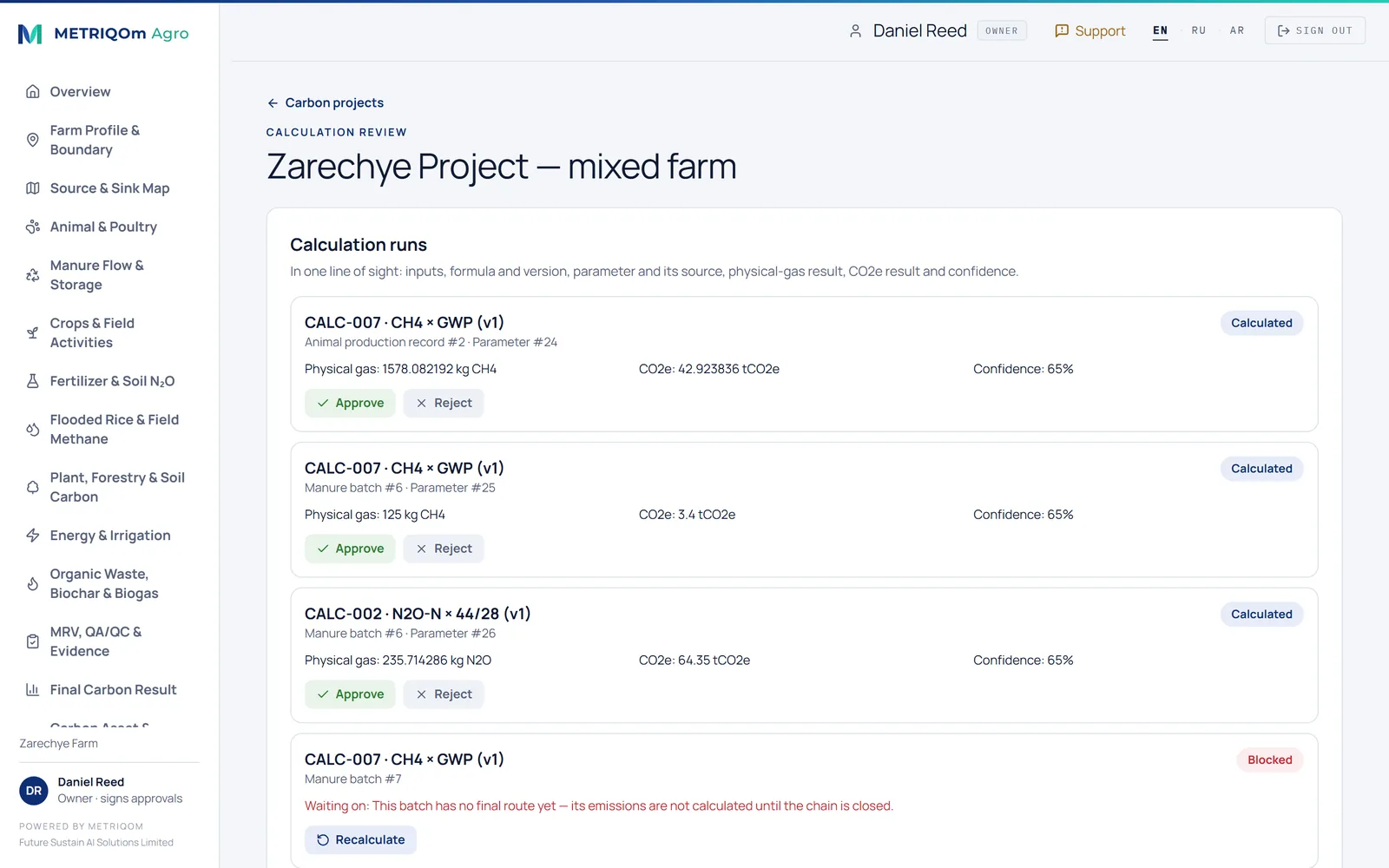
Inputs, formula, parameter and result on one line
Each run shows the record it came from, the formula and its version, the parameter, the physical gas, the CO₂e result and its confidence. A batch whose chain is not closed is not calculated — the run says why.
Readiness, not false confidence
A grade beside every number
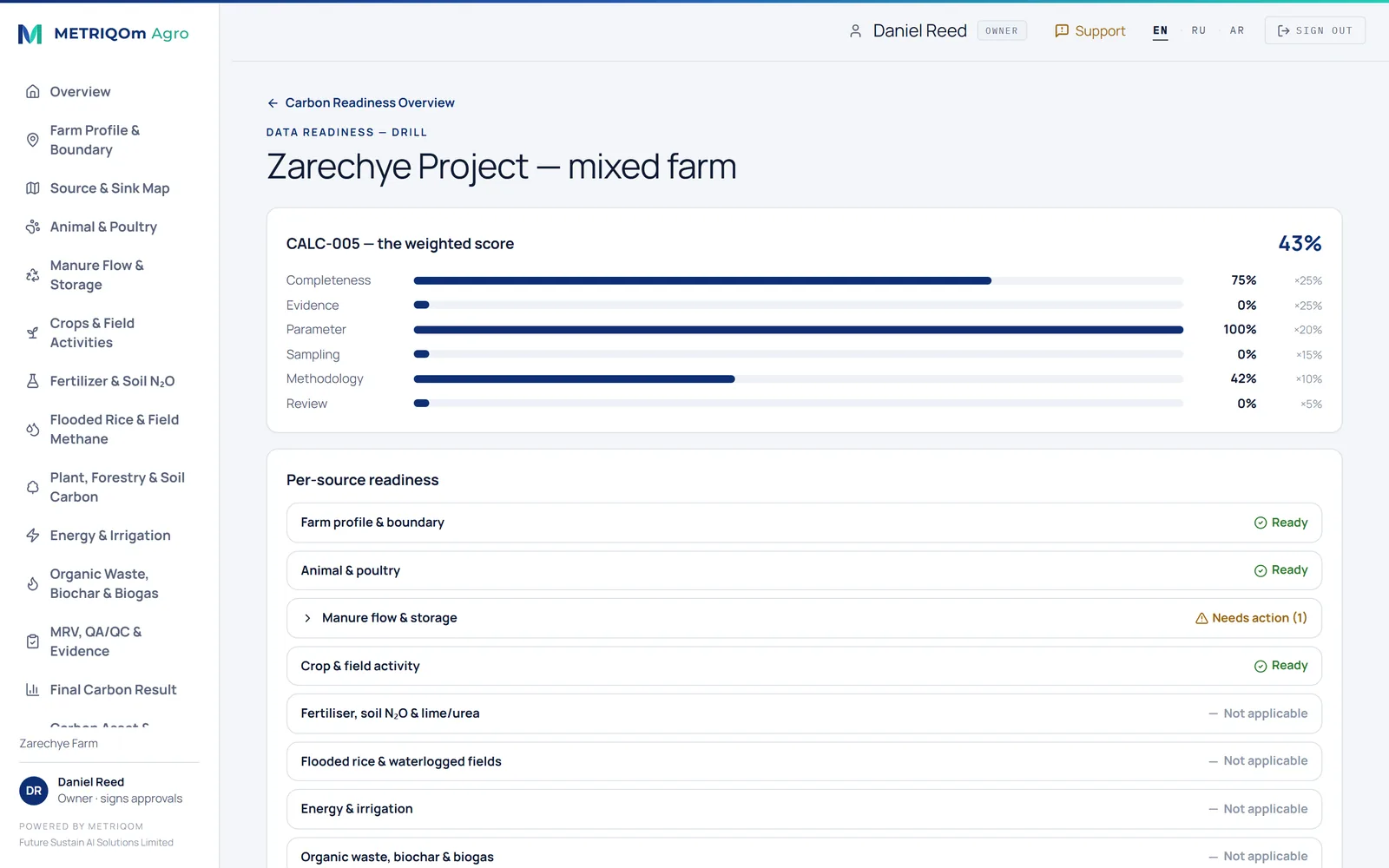
The readiness score weighs data completeness (25 %), evidence quality (25 %), parameter quality (20 %), sampling and measurement (15 %), methodology alignment (10 %) and independent review (5 %). It is an operational score — never presented as a statistical confidence interval.
Per-source readiness
The overview shows which layers are ready, which need action and which do not apply — so the next task is always the one that moves the grade.
The claim ladder
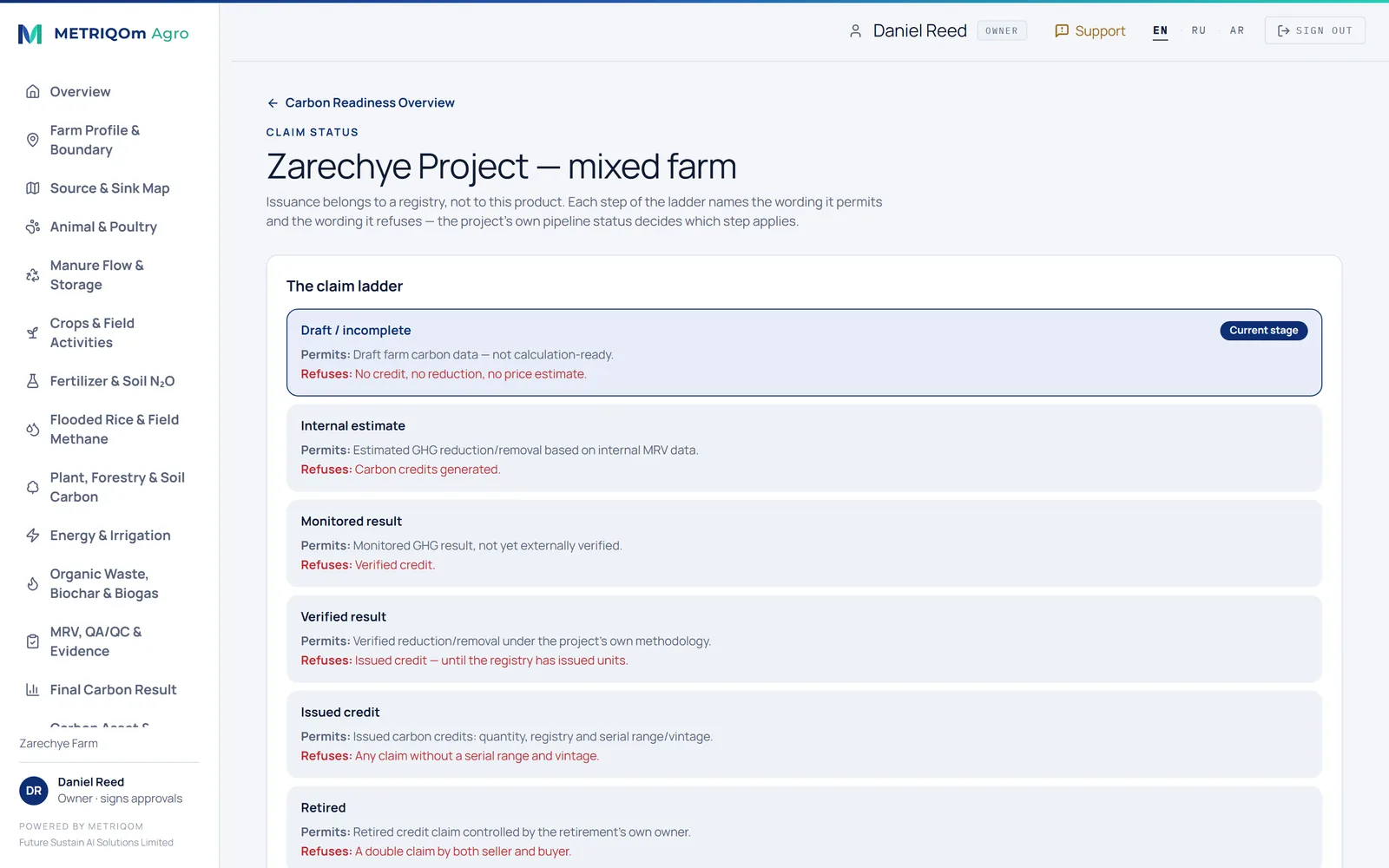
The wording matches the status — and no other
Reports, dashboards and exports use the wording that matches the project's status. Calculated results and credit assets live in two separate ledgers, and nothing moves from one to the other by arithmetic.
| Status | Allowed wording | Blocked wording | Evidence required |
|---|---|---|---|
| Draft / incomplete | "Draft farm carbon data — not calculation-ready." | No credit, no reduction, no price estimate. | — |
| Internal estimate | "Estimated GHG reduction/removal based on internal MRV data." | "Carbon credits generated." | Data confidence and formula source shown. |
| Monitored result | "Monitored GHG result, not yet externally verified." | "Verified credit." | MRV plan and evidence package. |
| Verified result | "Verified reduction/removal under [standard/methodology]." | "Issued credit" until the registry has issued units. | Verification statement or report. |
| Issued credit | "Issued carbon credits: [quantity], [registry], [serial range/vintage]." | Any claim without serial and vintage. | Locked asset ledger with registry serials. |
| Transferred | "Transferred credit quantity and owner recorded." | The farm continuing to claim transferred credits. | Buyer and owner linkage. |
| Retired | "Retired credit claim controlled by retirement owner." | A double claim by seller and buyer. | Retirement certificate, beneficiary and purpose. |
Eleven layers
Switched on for the sources a farm actually has
A set-up wizard activates the layers the farm needs and leaves the rest dark. The module keeps its own project records — boundary, activity data, evidence and parameters — each with its own approval.
Legal entity, fields and assets, carbon rights. Area is computed from the geometry.
Animal-days and bird-days, feed periods and production — enteric methane.
Each manure batch from source to storage and final route — methane and nitrous oxide.
Crop cycles, tillage, residues, irrigation and yield against each parcel.
A nitrogen ledger by field and date.
Flooding and drainage, water regime and cultivation days — field methane.
Fuel, electricity and refrigerants, classified by scope.
Composting, biochar batches and digester operation — benefit from measured operation only.
Plots, trees and soil samples with depth and lab method.
Net benefit = baseline − project − leakage − reversals + removals − uncertainty.
Potential credits after buffer and deductions; low, base and high price scenarios.
Scope 1, Scope 2 (location- and market-based) and Scope 3 category 3, over the farm's own records.
Controls
What the module refuses
- A parcel outside the project boundary
- An energy reading that overlaps an existing period
- A soil sample at a depth different from the programme
- An edit to a frozen baseline — it can only be revised under control
- Claim wording beyond the project's stage
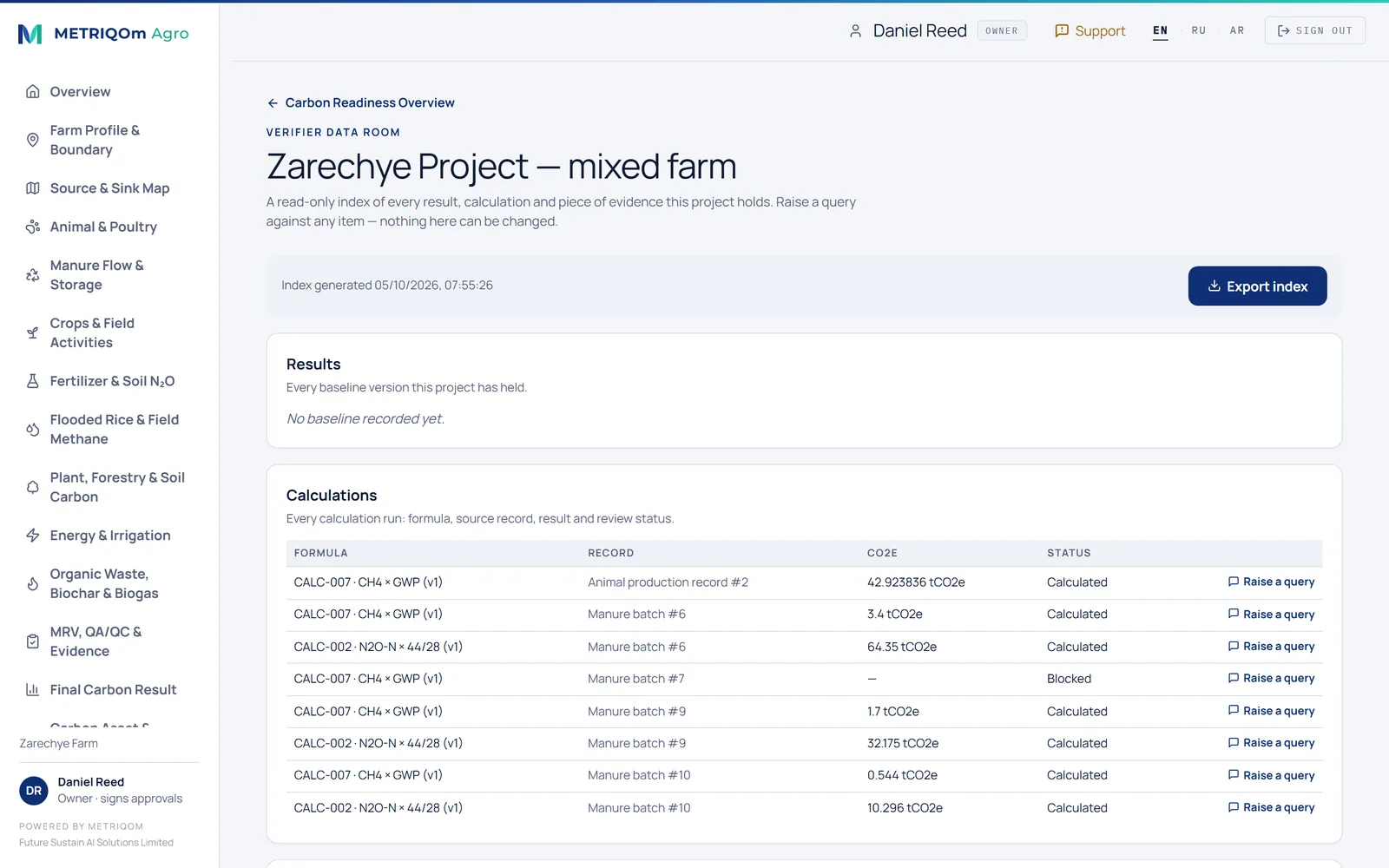
- Any write from the verifier's data room
Corporate totals are always gross: they are never reduced by removals or by the project's own credits. Scope 3 categories other than category 3 are listed as not yet captured.
Talk to us about carbon readiness
Carbon MRV is switched on per farm, alongside any edition.